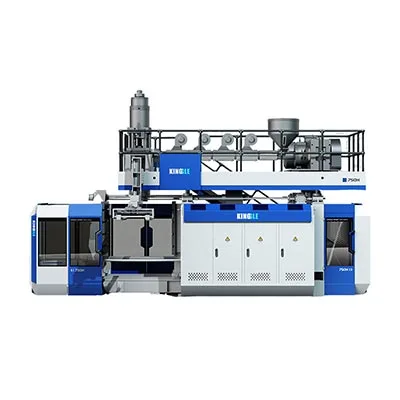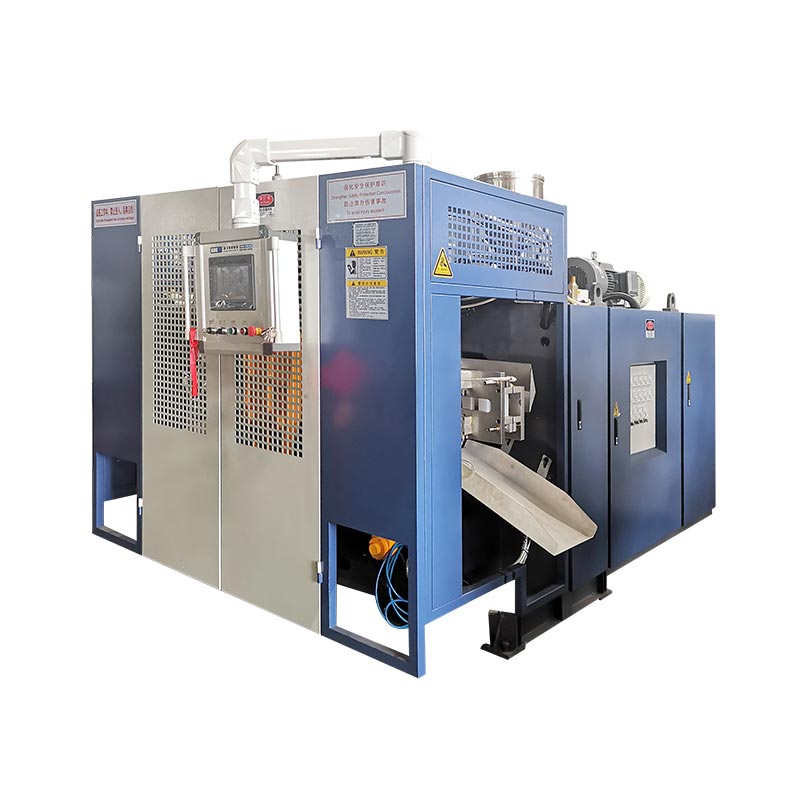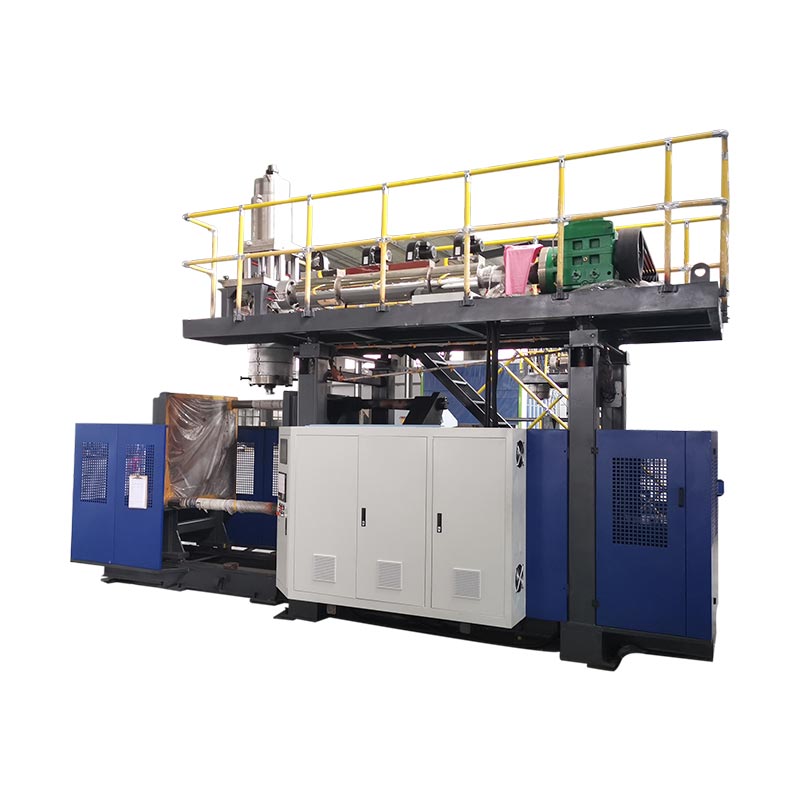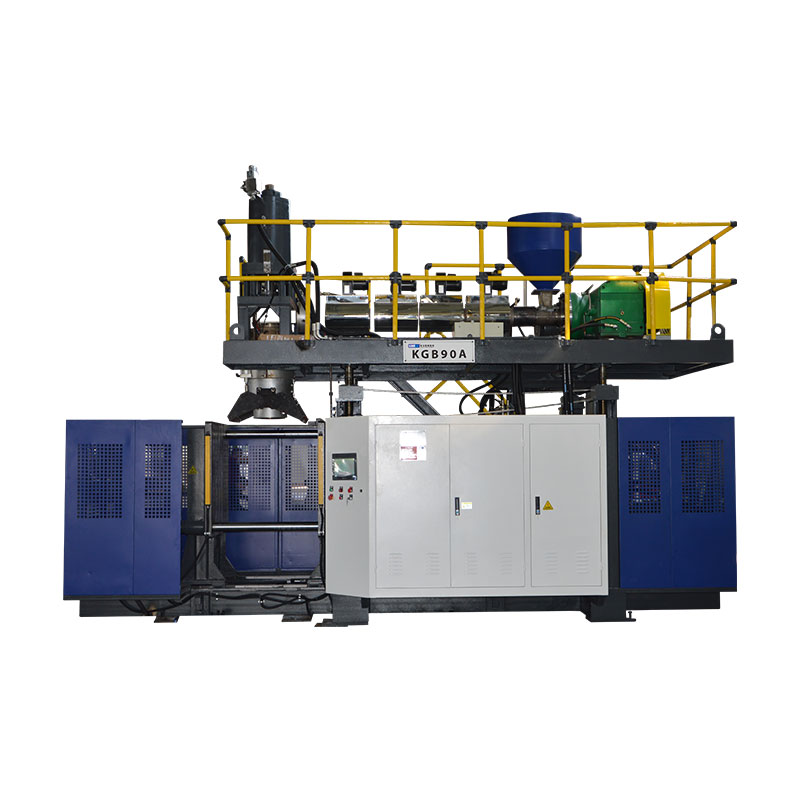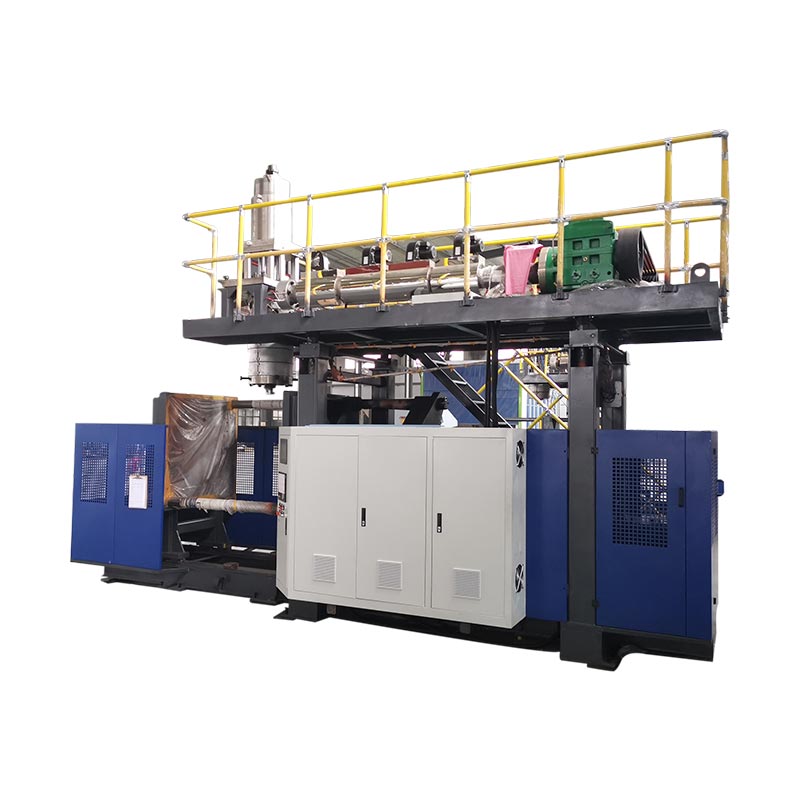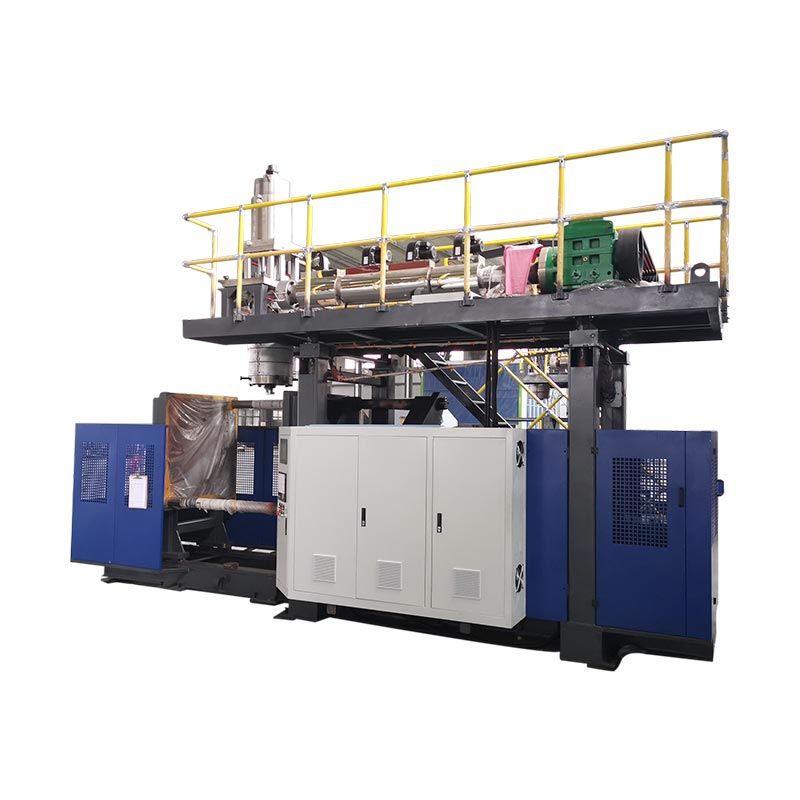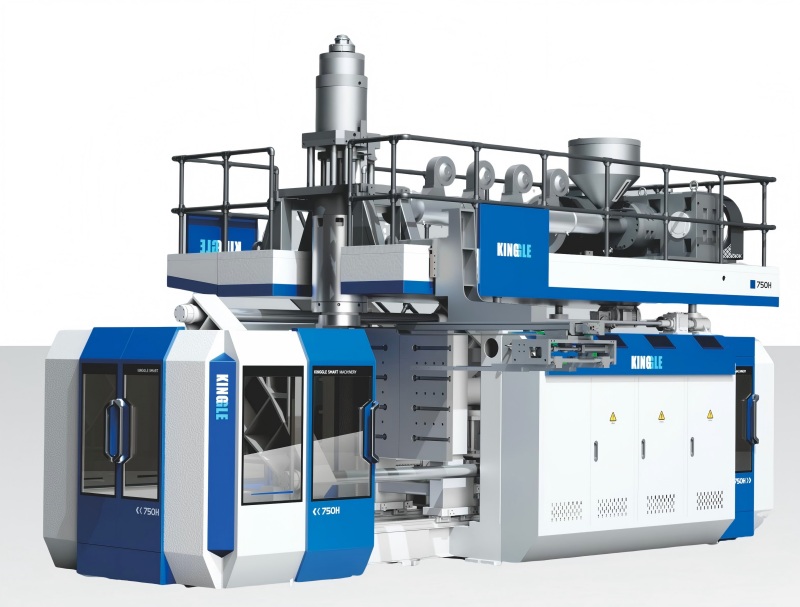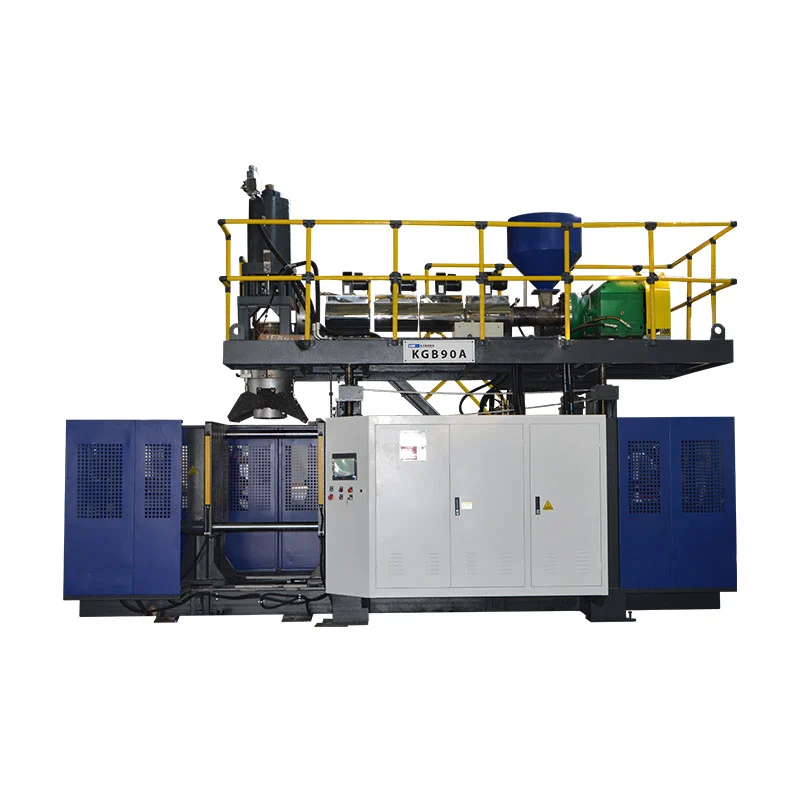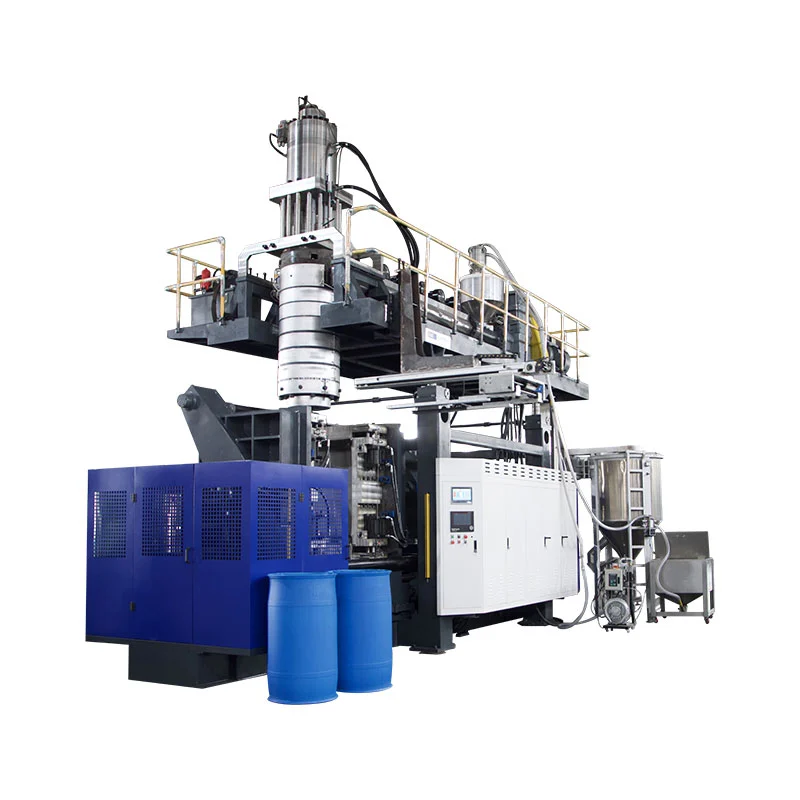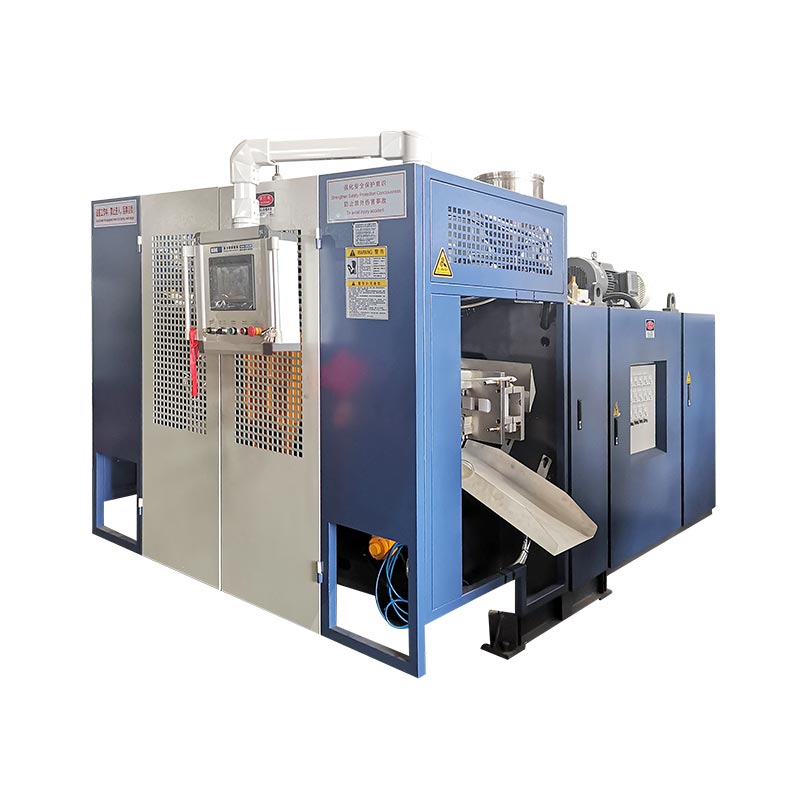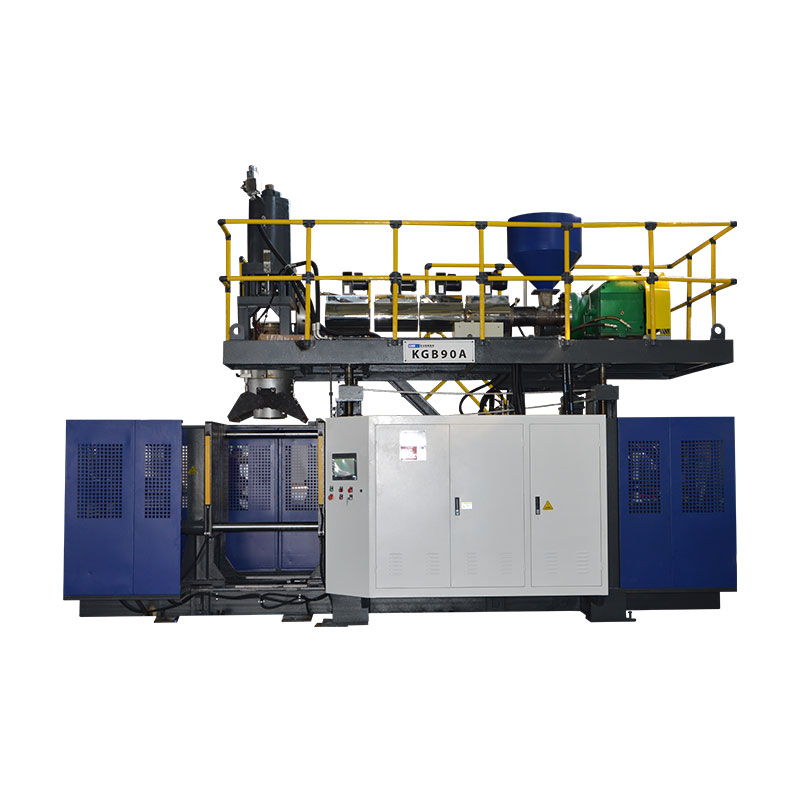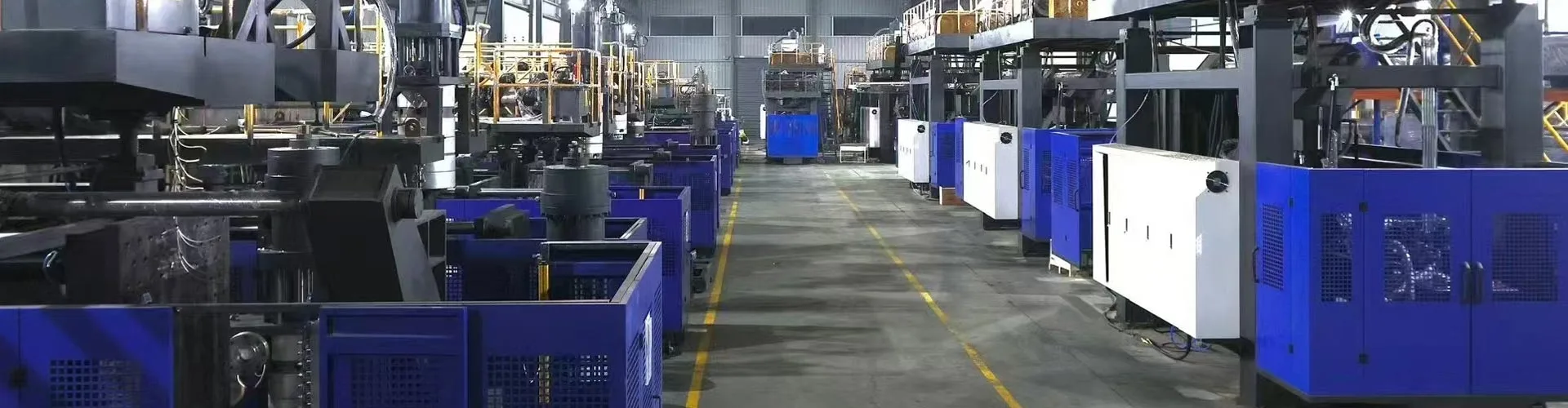
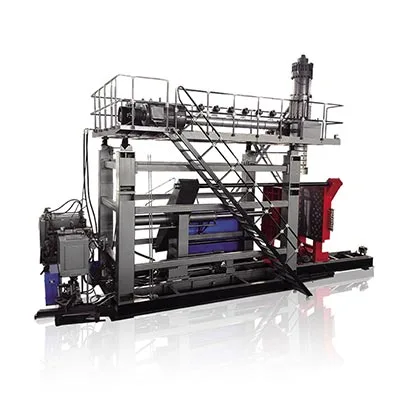
An IBC tank is the big roughly 1000-litre plastic bottle you've seen strapped inside a steel cage on a pallet, used to ship and store bulk liquids. That bottle is blow molded — and because it's so large, it needs the biggest accumulator machines made: three-cylinder storage heads, clamping forces around 1000 kN, and high-molecular-weight HDPE strong enough to hold a tonne of liquid without sagging or cracking. Kinggle's KGS1000L-IBC machine is built for exactly this: 1000 L capacity, 1000 kN clamping, twin 100 mm screws, and a 33 L accumulator on a 55-tonne frame.
You've handled the product even if you've never thought about how it's made. The IBC — intermediate bulk container — is everywhere: the caged 1000-litre tote that ships everything from liquid detergent to fruit concentrate to industrial chemicals. Walk through any logistics yard and they're stacked two high by the hundred.
What most people don't realise is that the plastic bottle inside that steel cage is a single blow-molded part. One shot. And making a hollow plastic container that holds nearly a tonne of liquid, survives stacking, and doesn't crack for years is one of the harder jobs in this whole industry. Here's how it's actually done, and what the machine has to be capable of to do it.
What an IBC tank actually is
Strip an IBC down and it's three parts. There's the blow-molded plastic bottle — the bit that holds the liquid. There's a welded steel tubular cage around it that takes the stacking load and stops the bottle bulging. And there's a pallet base, steel, plastic, or wood, so a forklift can move it. The cage and pallet are made and assembled separately. The blow molding line produces the bottle, and the bottle is where the engineering lives.
Standard capacity is around 1000 litres, sized so the whole unit fits a standard pallet footprint and stacks cleanly. That single number — 1000 litres of bottle, blown in one piece — is what dictates everything about the machine you need.
Why IBC bottles need the biggest machines made
We've written before about accumulator versus continuous machines, and the IBC sits at the far extreme of that story. To blow a 1000-litre bottle you first need a 1000-litre-sized parison — an enormous tube of molten plastic. A continuous die couldn't form that before gravity destroyed it. The parison would stretch, thin out, and tear under its own weight long before a mold could close on it.
So IBC machines use big storage heads — often three-cylinder accumulators — that collect a massive charge of melt and then fire it out fast, getting the whole parison into the mold before it can sag. That demands serious hardware: a large accumulator volume, a clamping force around 1000 kN to hold a mold that big shut against blow pressure, and twin screws to plasticise enough material quickly. These aren't scaled-up bottle machines. They're a different class of equipment.
The machine, in real numbers
Generic talk about "big machines" doesn't help you spec a line, so here are the actual figures for Kinggle's KGS1000L-IBC machine straight from our catalogue:
| Max container capacity | 1000 L |
|---|---|
| Clamping force | 1000 kN |
| Screw diameter | 100 mm × 2 (twin screw) |
| Screw L/D ratio | 32 |
| HDPE plasticising | 180 × 2 kg/hr |
| Accumulator capacity | 33 L |
| Mold platen size | 1800 × 1800 mm |
| Output (dry cycle) | 150 pc/hr |
| Average energy use | 110–150 kW |
| Machine weight | 55 T |
| Machine footprint | 9.5 × 5.1 × 6.5 m |
| Blow pressure | 0.8 MPa |
A 55-tonne machine with a footprint nearly ten metres long isn't a purchase you make casually, and the 110–150 kW power draw is a real operating line item. But for anyone producing IBCs at volume, this is simply what the part requires. If you also make 2000-litre tanks, the three-cylinder KGS135A and KGS150A step up to 1800 kN of clamping for the same reasons, just larger.
Why HMWHDPE instead of ordinary HDPE
The material matters as much as the machine, and IBC bottles are made from HMWHDPE — high molecular weight high-density polyethylene — not the standard HDPE you'd use for a detergent bottle. The reason comes down to one property: stress-crack resistance.
An IBC bottle holds close to a tonne of liquid, day in and day out, often stacked with another full unit on top. That's constant load on relatively thin walls, for years. Ordinary HDPE under that kind of sustained stress eventually develops environmental stress cracks — tiny fractures that grow until the bottle leaks. HMWHDPE, with its longer polymer chains, resists that cracking far better and holds its stiffness under load. It's harder to process — it's stiffer in the melt and needs more plasticising power, which is part of why the KGS1000L-IBC runs twin screws — but for a container that has to survive this duty cycle, it isn't optional.
The wall-thickness problem at 1000 litres
If there's one thing that separates a good IBC bottle from a reject, it's wall thickness — specifically, keeping it even. Picture that giant parison hanging in the moment before the mold closes. The top is carrying the weight of everything below it, so it wants to thin out up high and bunch up low. Left unmanaged, you get a bottle that's dangerously thin at the shoulders and wastefully thick at the base.
Thin shoulders are exactly where an IBC fails — under stacking load or during the pressure test it has to pass. So these machines lean hard on programmable wall-thickness control, varying the die gap through the shot to lay down more material where the bottle needs it and less where it doesn't. It's the same battle against parison sag that every large part fights, just at the most demanding scale in the business. Our guide to blow molded product tolerances goes deeper on what "even wall" means in actual numbers.
UN certification: what a bulk-liquid IBC has to pass
Plenty of IBCs carry water, food liquids, or harmless detergents and don't need special approval. But the moment an IBC carries dangerous goods — solvents, acids, flammable liquids — it has to be UN-certified, and that changes the bar the bottle has to clear.
Certification tests the IBC as a complete unit — bottle, cage, and pallet together — not just the bottle. The design goes through stacking, drop, leakproofness, and internal pressure tests, and a design that passes earns a UN marking (you'll see codes like 31HA1 on a composite IBC, meaning a rigid plastic inner with a metal outer). Certified units also need periodic retesting across their service life. None of that testing is the machine's job directly. But whether the bottle passes is decided on the production line: even walls, no thin spots, consistent material distribution. A bottle that varies in wall thickness fails the pressure test, full stop. Which is why, for certified work, the wall-thickness control above isn't a nicety — it's the difference between a sellable product and scrap.
Where IBC tanks end up
IBCs show up across most of the industries Kinggle's machines serve. The obvious ones are chemicals and bulk liquids — industrial chemicals, cleaning concentrates, lubricants. Food and beverage uses them for syrups, oils, juice concentrate, and other liquids moved in bulk. Agriculture relies on them for fertilisers and crop-protection liquids. Water treatment, construction admixtures, and pharmaceutical intermediates all ship in IBCs too.
For chemical service specifically, some IBC bottles are co-extruded with a barrier layer for extra resistance — which is where this connects to multi-layer co-extrusion. The principle is the same as a fuel tank: bury a barrier in the wall to keep an aggressive liquid from permeating or attacking the polyethylene over a long storage life.
What to check before ordering an IBC line
If you're sizing up an IBC machine, a few things are worth nailing down before you sign anything:
- Realistic output, not dry-cycle. The catalogue figure is a ceiling. A 1000-litre wall takes real time to cool before it can eject without deforming, so plan capacity on achievable rates.
- Wall-thickness control capability. For certified IBCs this is non-negotiable. Ask exactly how many control points the system manages along the parison.
- HMWHDPE handling. Confirm the plasticising setup is specified for high molecular weight material, not standard HDPE — they don't process the same.
- Footprint and services. A 55-tonne, ten-metre machine drawing 110–150 kW needs the floor space, foundation, power, and cooling water to match. Check your plant can host it before it ships.
- Whether you need barrier capability. If you'll run aggressive chemicals, decide up front whether you need co-extrusion for a barrier layer — it changes the machine spec.
Frequently asked questions
What is an IBC tank and how is it made?
An IBC (intermediate bulk container) is a roughly 1000-litre container for shipping and storing bulk liquids. The part that holds the liquid is a single blow-molded plastic bottle; it sits inside a welded steel tubular cage mounted on a pallet. The cage and pallet are assembled separately — the blow molding machine makes the bottle, which is the hard part.
Why are IBC bottles made from HMWHDPE?
High molecular weight HDPE has much better environmental stress-crack resistance and stiffness than ordinary HDPE. An IBC bottle holds close to a tonne of liquid and gets stacked, so its thin walls have to resist cracking under constant load for years. Standard HDPE would not survive the duty cycle; HMWHDPE does.
What machine do you need to blow mold a 1000L IBC?
You need a large storage-head (accumulator) machine. Forming a 1000-litre parison means a big accumulator, a clamping force around 1000 kN, and enough plasticising capacity to push that much melt fast before it sags. Kinggle's KGS1000L-IBC provides 1000 kN clamping, twin 100 mm screws, and a 33-litre accumulator on a 55-tonne frame.
Can blow-molded IBCs carry hazardous chemicals?
Yes, if the design is UN-certified for dangerous goods. The bottle, cage and pallet are tested as a unit — stacking, drop, leakproofness and internal pressure tests — and certified designs carry a UN marking such as 31HA1 for a composite IBC. Certified units also require periodic retesting over their service life. The machine's job is to produce a bottle with even, consistent walls so it can pass.
How many IBC bottles can one machine produce per hour?
Kinggle's KGS1000L-IBC is rated at around 150 pieces per hour as a dry-cycle figure. Real output is lower once cooling and handling of a part this large are factored in, since a thick 1000-litre wall takes time to cool enough to eject without deforming. Plan capacity on realistic rates, not the dry-cycle maximum.
Planning an IBC production line?
Tell us your target output, the liquids you'll fill, and whether you need UN-certified or barrier IBCs, and our engineers will spec the machine, the material handling, and the wall-thickness setup to match. We've been building blow molding machines since 2002, with 15 engineers on the team.
Talk to us about an IBC machine →An IBC bottle looks simple — it's just a big plastic box, after all. But holding a tonne of liquid in one blow-molded part, year after year, is genuinely hard engineering, and it asks for the largest, most capable machines in the catalogue. Get the machine, the material, and the wall control right, and you've got a container that ships the world's bulk liquids safely. Browse the full large accumulator range to see where an IBC line fits.