On this page
- What is a blow molding machine?
- How blow molding works
- Types by process: EBM, IBM, ISBM
- Inside the machine: parts that decide quality
- Types by structure and the model range
- Materials we run
- What blow molding machines make
- Output and cost: the numbers that matter
- How we help you choose
- Quality, testing and what we watch
- What drives machine price
- Buying from a manufacturer
- FAQ
What is a blow molding machine?
A blow molding machine turns plastic resin into hollow parts by melting it, forming it into a soft shape, and blowing compressed air inside that shape so it presses out against a mold. When the plastic cools and the mold opens, you have a finished hollow product — a bottle, a can, a drum, a tank. Almost every rigid plastic container you handle started on a blow molding machine of one kind or another.
The category is broad because the parts are so different: a 100 ml eyedropper bottle and a 220 L chemical drum are both "blow molded," but nothing about the two machines is the same. Choosing well means understanding two things — how the soft shape is formed (the process type), and how the machine is built to deliver it (the structure). We'll take both in turn.
How blow molding works
Extrusion blow molding — the process behind most industrial containers — runs in a tight loop. Understanding it makes every later decision (cost, output, quality) obvious:
- Melt and meter. An extruder screw melts the resin and pushes a steady, homogeneous flow toward the die head.
- Form the parison. The melt exits the die head as a hollow tube — the parison. A wall-thickness controller profiles that tube along its length so plastic sits where the part needs strength.
- Clamp. The mold closes around the parison. Synchronous clamping and direct-pressure locking hold the platens parallel so the part won't flash.
- Blow. A blow pin injects air (with a bottom-blowing system on many parts) and the parison inflates against the cavity, taking its final shape.
- Cool. The part sets against the cooled mold. This is usually the longest step, and it — not the extruder — sets your cycle time.
- Eject and finish. The mold opens, a robot arm removes the part, and flash is trimmed. On an automated line this runs unmanned.
Two of these steps quietly decide the economics of the whole line. Parison profiling sets how much resin every part carries; cooling sets how fast you can make them. Get those two right and the rest of the machine largely takes care of itself — which is why they deserve more attention than the headline specs buyers usually compare first.
Types by process: EBM, IBM and ISBM
There are three core process types of blow molding machine. The difference is entirely in how the soft shape is made before it's blown.
| Type | How the shape is formed | Best for | Typical products |
|---|---|---|---|
| Extrusion (EBM) | Parison extruded as a tube, then blown | Handled and large hollow parts | Jerry cans, drums, tanks, bottles |
| Injection (IBM) | Preform injection-molded, then blown | Small, high-precision containers | Pharma bottles, cosmetic jars |
| Injection stretch (ISBM) | Preform injected, stretched and blown | Clear, strong PET bottles | Water and soft-drink bottles |
Extrusion blow molding (EBM) is the workhorse for industrial containers and the process we build. Because the body, handle and neck form in one shot, EBM makes handled and large parts that the other processes can't. Injection blow molding (IBM) molds a precise preform first, giving excellent small-bottle neck accuracy but no handles and no large parts. Injection stretch (ISBM) stretches a PET preform for the clarity and strength you see in water bottles — a different product family from HDPE industrial parts.
In practice the choice is rarely ambiguous. A can, drum, tank or any handled or large container is an extrusion part; IBM and ISBM belong to small precise bottles and clear PET. Knowing which family your product falls into before you shortlist machines saves comparing quotes for two processes that were never going to fit.
Inside the machine: the parts that decide quality
Two machines can share the same headline capacity and behave completely differently, because quality lives in the components. These are the parts our engineers care about most:
| Component | What it does | Why it matters |
|---|---|---|
| Extruder and screw | Melts and meters the resin | 50–100 mm screws at 24–25 L/D give a stable, homogeneous HDPE melt — the base of consistent parts |
| Die head + parison controller | Forms and profiles the parison wall | A MOOG 100-point wall-thickness controller is the single biggest lever on resin cost and part strength |
| Clamping unit | Closes and holds the mold | Double pull-rod synchronous clamping + oil-cylinder direct-pressure lock keep platens parallel under high tonnage |
| Blow and cooling | Inflates and sets the part | Blow pin + bottom blowing shape the part; cooling design drives the real cycle time |
| Drive and control | Powers and runs the machine | Servo main pump cuts energy; Mitsubishi PLC + Weinview HMI protect uptime on 24/7 lines |
| Automation | Take-out, deflashing, inspection | Robot arm + downstream trimming keep quality stable on unmanned runs |
On a line running around the clock, control reliability is what protects yield — which is why the imported components in that last row matter more than they look. Mitsubishi PLC, Weinview HMI and MOOG wall-thickness control aren't badges; they're proven parts that stay serviceable almost anywhere in the world, so a fault in Lagos or Lima doesn't idle the line for weeks.
Types by structure and the model range
Within extrusion, machines are grouped by how the parison is delivered and how the wall is built. This is where you match the machine to your part size and volume.
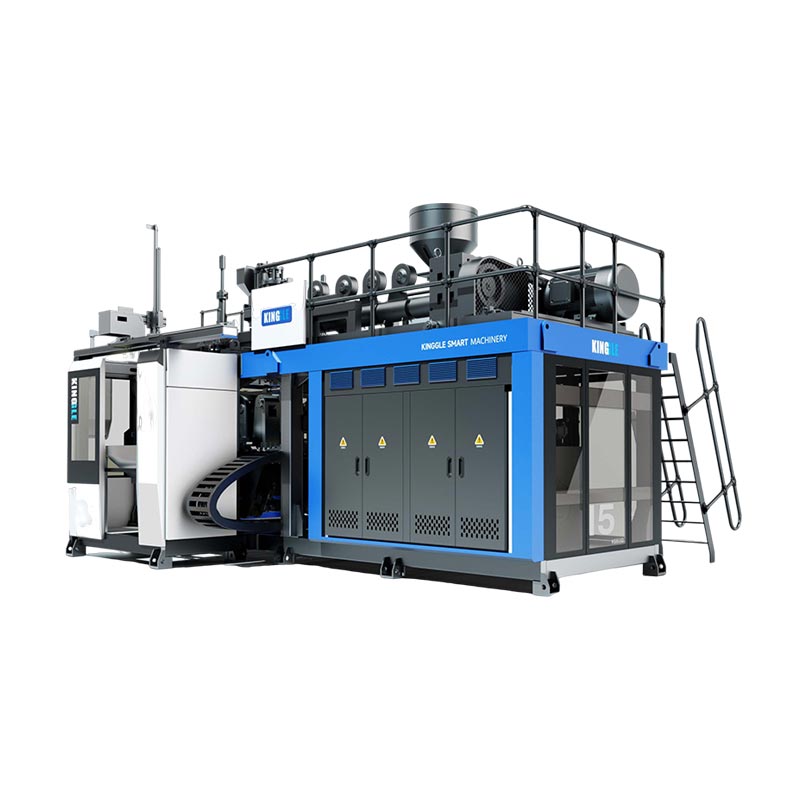
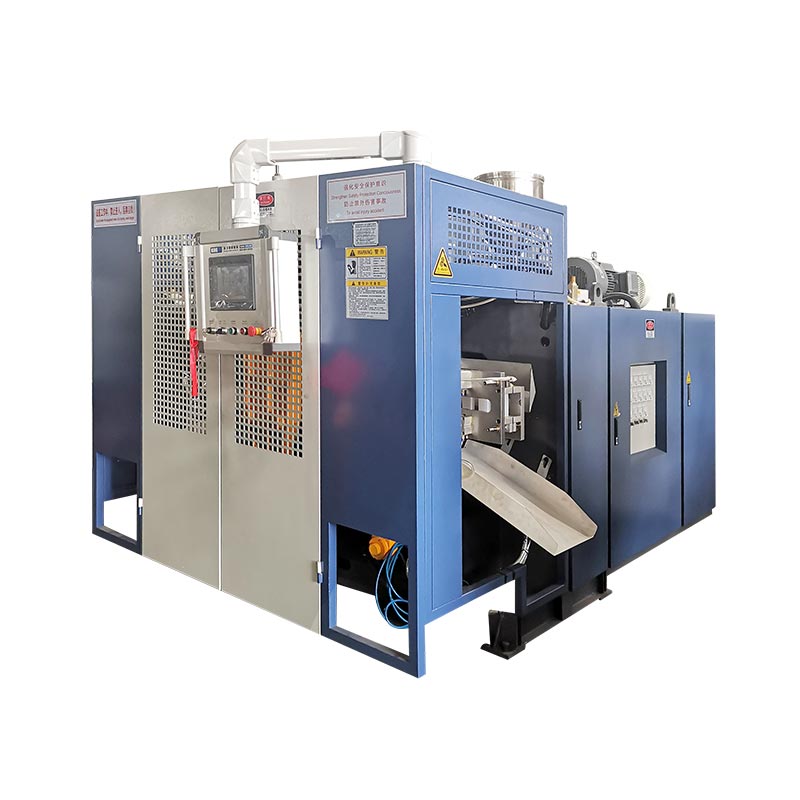
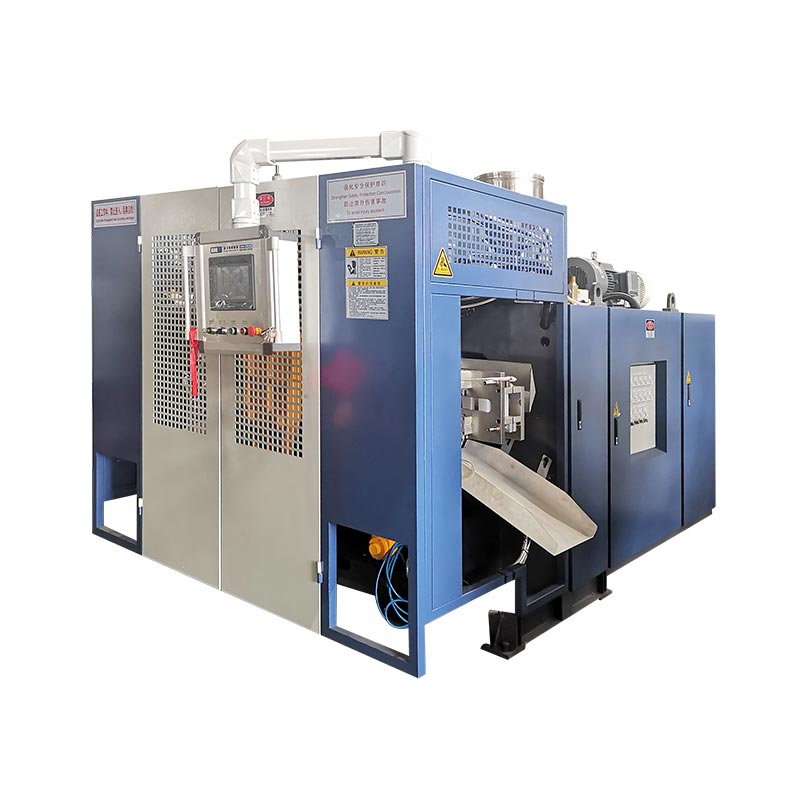
- Continuous blow molding machine. The parison extrudes non-stop and the mold shuttles to catch it — high cadence on small-to-medium parts up to about 30 L, and where a multi-die head runs bottles several-up.
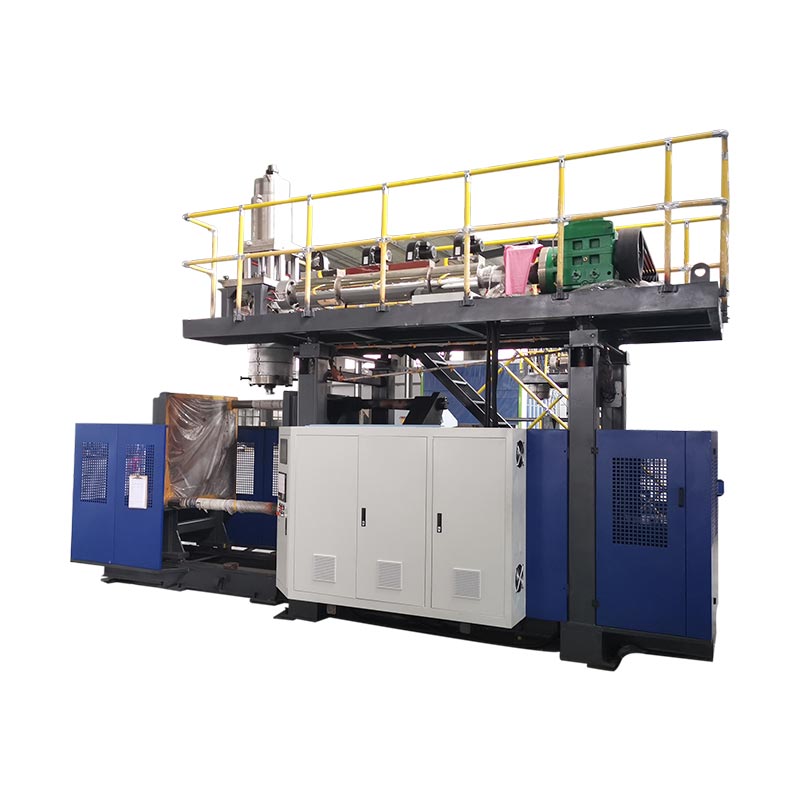
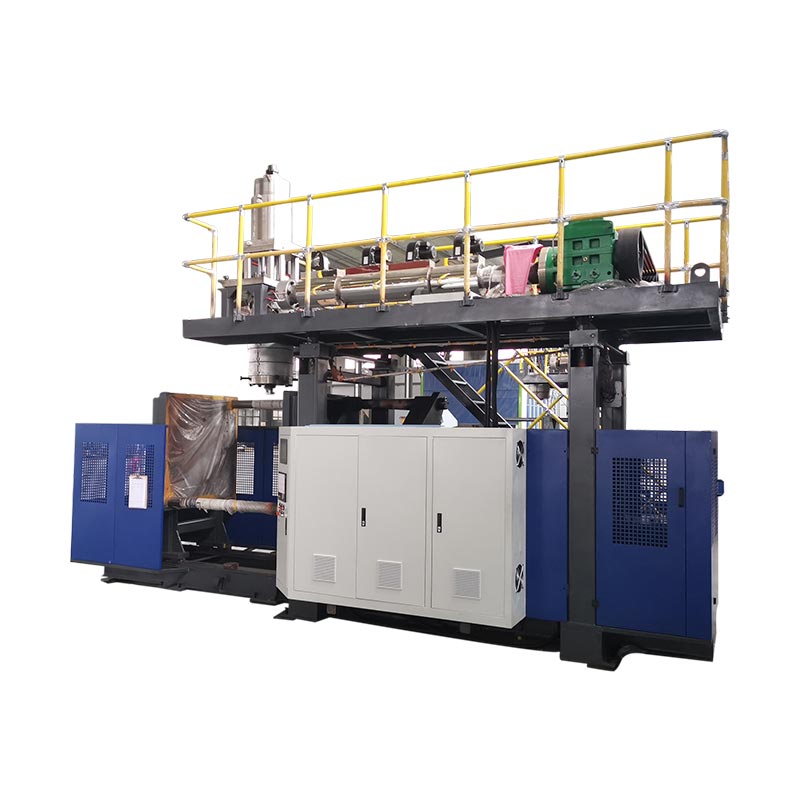
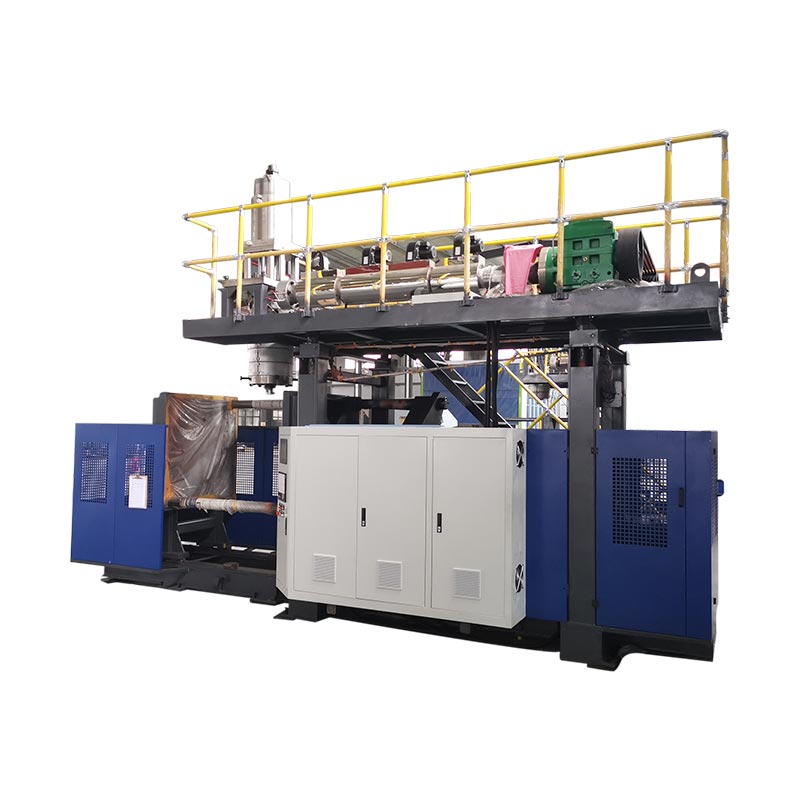
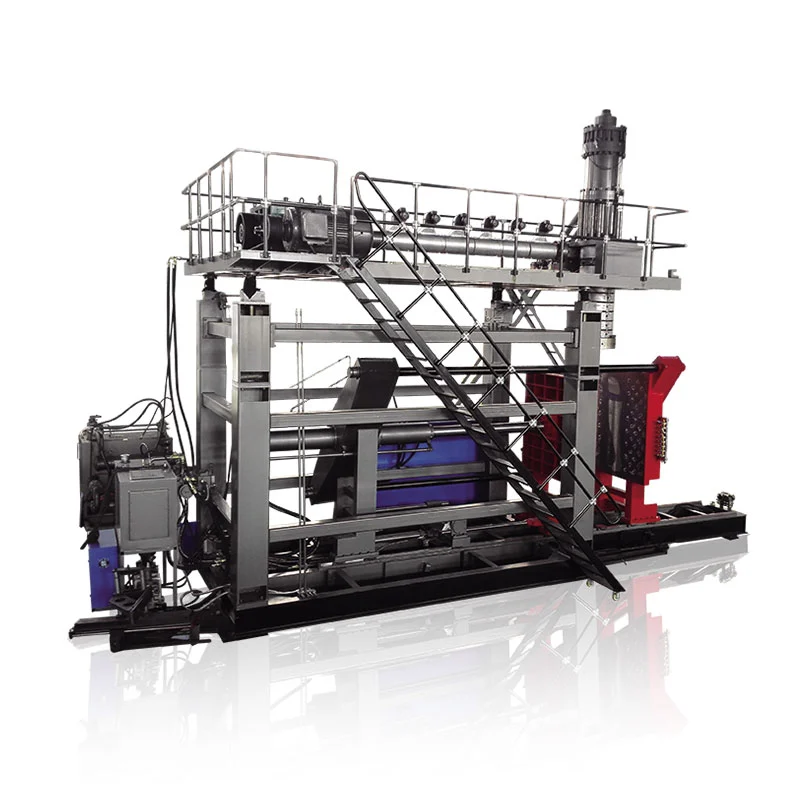
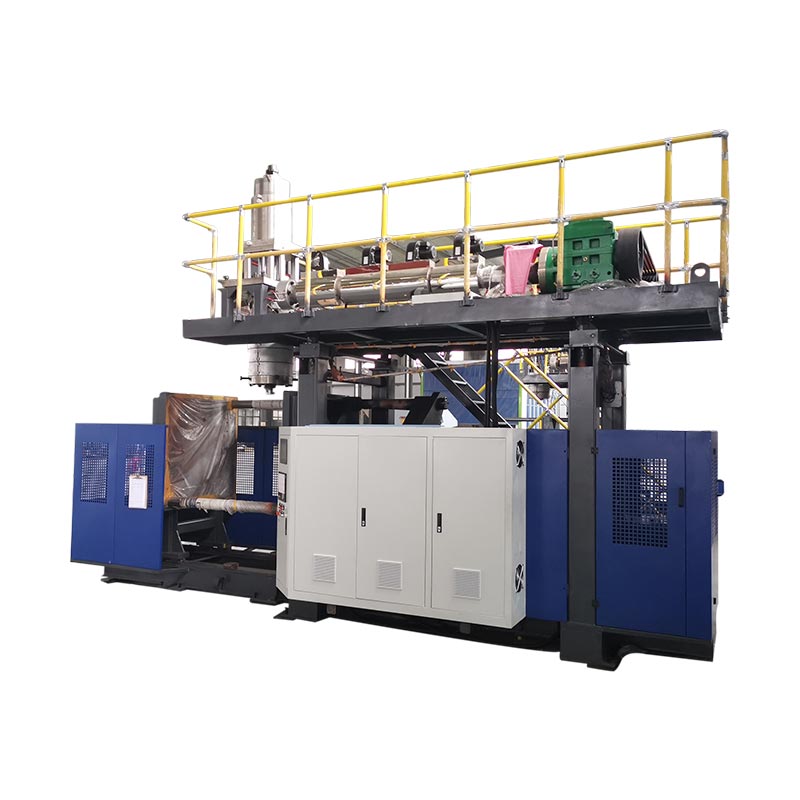
- Accumulator (accumulate) blow molding machine. Melt stores in the head and shoots fast, stopping large parisons sagging — the type for drums, IBC tanks, fuel tanks and barriers.
- Multilayer blow molding machine. A 2–6 layer die head co-extrudes barrier, regrind or color layers into one wall — used for fuel tanks and high-spec chemical drums.
- Automatic blow molding machine. Any of the above with full automation — robot take-out, deflashing and inspection for unmanned, consistent running.
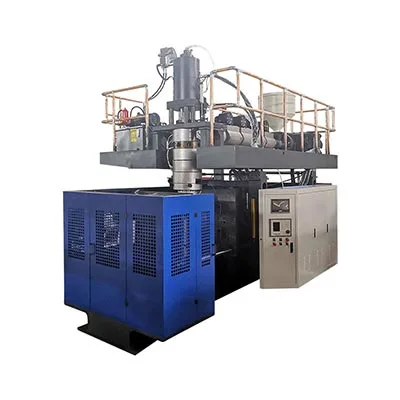
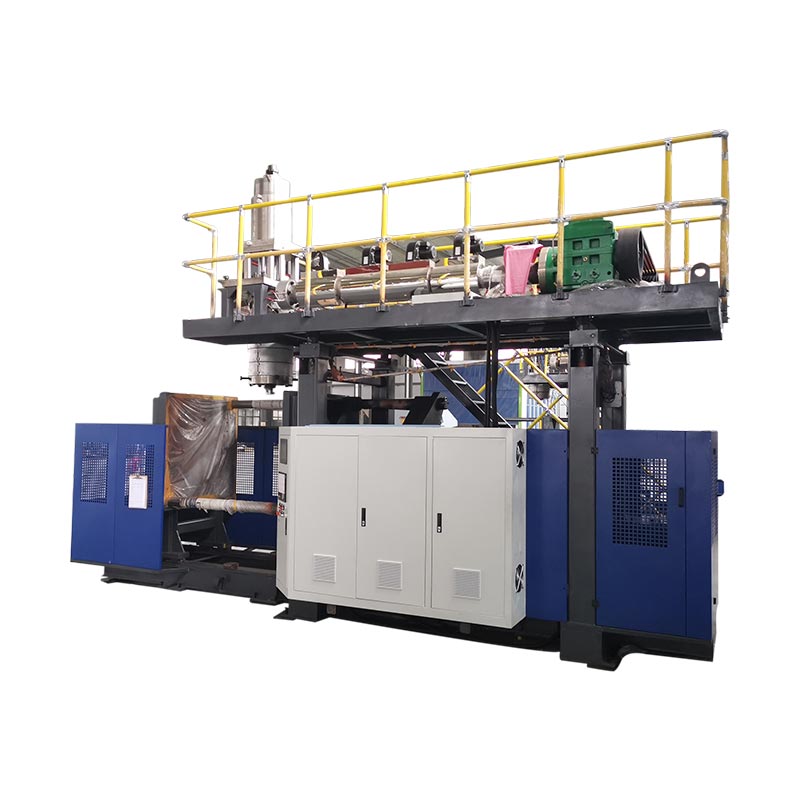
Our own range spans 100 ml to 220 L drums (and larger on request), so the same factory covers a small oil bottle and a UN-rated chemical drum:
| Capacity | Machine type | Example models | Dry-cycle output* | Clamping |
|---|---|---|---|---|
| 100 ml – 2 L | Continuous, single/multi-die | 2L single / double station | up to 1,200/h | 40 kN |
| 3 – 15 L | Continuous, single/double | 5L / 15L station | 450–1,000/h | 65–200 kN |
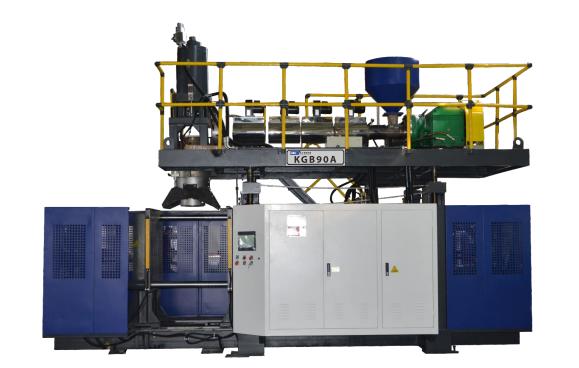
| 20 – 60 L | Accumulator | KGB70A / 80A / 90A | 500–700/h | 130–280 kN |
| 120 – 160 L | Accumulator | KGB100B / 110A | 300–320/h | 440–760 kN |
| 220 L drums+ | Chemical-barrel special | 250L special | 17–20/h | on request |
*Dry-cycle is the theoretical maximum; real output is lower. Full specs and worked numbers are in our deep dives on the jerry can machine and accumulate machine.
Materials we run
The machine sets the process; the resin sets the properties. Our extrusion machines run the industrial family below in single or multilayer walls.
| Material | Why it's used | Typical parts |
|---|---|---|
| HDPE | Stiff, chemical-resistant, low cost | Jerry cans, bottles, tanks |
| HMW-HDPE | High impact and stress-crack resistance | Chemical drums, fuel tanks |
| PP | Heat resistance, clarity options | Thin-wall and hot-fill containers |
| PVC / PA | Barrier and specialty properties | Specialty bottles, barrier layers |
What blow molding machines make
Change the mold and one machine family serves many industries. These are the application areas we tool for most:
| Industry | Products |
|---|---|
| Packaging | Oil and detergent bottles, jerry cans, chemical drums, IBC tanks |
| Automotive | Fuel tanks, air ducts, spoilers |
| Road administration | Traffic barriers, cones, isolation piers |
| Floating | Buoys, floats, pontoons |
| Logistics and more | Pallets, toolboxes, tables and chairs, toys |
Output and cost: the numbers that matter
Two calculations decide whether a machine fits your business — and both are easy to run before you buy.
Example — a 5 L can at a 7.2 s cycle, single head:
(3600 ÷ 7.2) × 0.8 = 400 cans/h · two shifts ≈ 6,400/day
Resin = part weight × resin price → e.g. 0.20 kg × $1.30 = $0.26
Energy = machine kW × $/kWh ÷ parts/h → e.g. 15 × 0.12 ÷ 400 = $0.0045
Notice that resin dwarfs energy and labor in cost per part. That single fact is the whole case for precise wall-thickness control: trimming 5% of resin from a part that ships by the million saves far more than any electricity bill — and it's why a cheaper machine with weak wall control usually turns out to be the expensive one.
How we help you choose
When a buyer sends an enquiry, we work through the part, not the machine. Answer these and the right configuration is usually clear:
- Largest part and shape. Size and whether it has a handle decide extrusion vs injection, and continuous vs accumulator.
- Resin and wall spec. Barrier or regrind layers need a multilayer head; UN-rated drums need strong wall-thickness control.
- Daily output. Run the output math against two-shift hours before choosing single vs double station.
- Certification. Drop-test or UN requirements change tooling and validation.
- Standalone or turnkey. Scaling lines benefit from central feeding, water and crushing supplied together.
Quality, testing and what we watch
Consistency is the whole game in blow molding, and it's where two decades of building the same machines shows up. A few things we do and watch:
- Wall-thickness uniformity. Profiled point-by-point so every part meets its drop-test spec with the least resin — checked before shipment.
- Drop test and UN validation. Chemical-drum tooling passes a 3-metre drop test and UN certification before it leaves our floor.
- Where falling output usually starts. Slower cycles more often trace to the storage stroke or cooling than to the extruder — that's the first place to look, not the last. (More in what causes slow material storage.)
What drives machine price
There's no single list price for a "blow molding machine" because the spec swings the cost. The main drivers:
- Part size and clamping force. Bigger parts need heavier frames and far higher tonnage — the biggest cost driver.
- Number of die heads. Twin/multi-die multiplies output and price.
- Single vs multilayer. A multilayer head adds capability and cost.
- Automation and controls. Robot take-out, deflashing and premium controls raise price but lower running cost.
- Turnkey systems. Central feeding, water and crushing add to the quote but cut waste and labor.
Buying from a manufacturer
A machine is a decade-long relationship, so who stands behind it matters as much as the spec. As the factory, we back every machine with:
- Warranty. Main components carry a 1–2 year warranty; wearing parts are replaced free within the first year.
- Install and training. Our engineers travel to your factory to install, commission and train your operators.
- Remote support. An on-board alarm system lets us diagnose and troubleshoot problems remotely.
- Custom solutions. Molds to your drawings and configurations tuned to your part, resin and output.
Tell us your part — we'll spec the machine
Send your product, size, resin and daily output. We'll recommend the right type, configuration and clamping force, with real cycle figures.
Get a Quote Chat on WhatsAppFrequently asked questions
What is a blow molding machine?
It makes hollow plastic products by melting resin, forming it into a soft shape, and inflating it with air inside a mold — used for bottles, jerry cans, drums, tanks, fuel tanks and more.
What are the types of blow molding machine?
By process: extrusion (EBM), injection (IBM) and injection stretch (ISBM). By structure: continuous, accumulator and multilayer. By operation: automatic. Extrusion is the most common for industrial HDPE containers.
How much does a blow molding machine cost?
Price is driven by part size and clamping force, number of die heads, single vs multilayer, and automation. A small single-station machine costs far less than a large accumulator drum line — share your part and output for an accurate quote.
How do I choose the right one?
Start from the part: largest size, handle or not, resin, wall spec, certification, then daily output. Handled and large parts use extrusion (continuous for small–medium, accumulator for large); precise small bottles use injection; clear PET bottles use injection stretch.
Which materials can it run?
Extrusion machines run PE (HDPE and HMW-HDPE), PP, PVC and PA in single or multilayer walls. Injection stretch machines run PET for clear bottles.
How is output measured?
Spec sheets show dry-cycle (theoretical) output. Real output is dry-cycle × about 0.75–0.85, because cooling time and part weight lengthen the real cycle.